
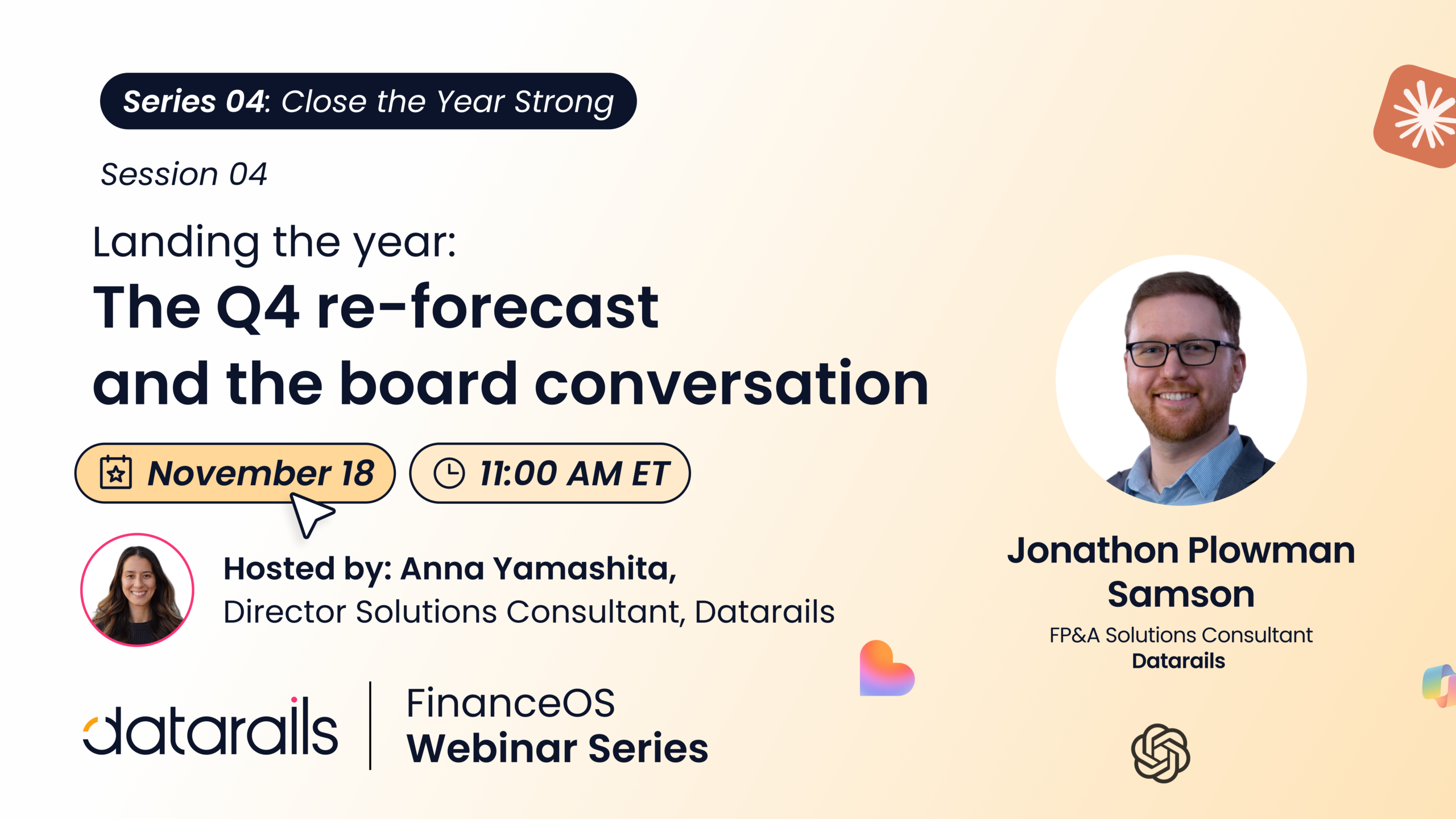
Q4 Reforecast: Building One You Believe Before the Board Meeting

Key takeaways
- Where a reforecast goes wrong: A Q4 reforecast can add up to the annual plan and still be a number nobody in finance believes, because the gap has been pushed into December.
- What makes one believable: Phasing from what's committed and what's in the pipeline, instead of from what's needed to hit the budget.
- How to take it to the board: Lead with where you'll land and the range around it, then explain what changed since the last forecast and whether it's timing or run-rate.
- The session: Datarails Solution Consultant Jonathon Plowman-Samson covers the Q4 reforecast, how to communicate a beat or miss, and how to prepare for the questions the board will ask.
It’s mid-November and the CFO asks the question every finance team has been waiting for: where will we land? The Q4 forecast still adds up to the annual plan. October came in light, but November and December have been nudged up to cover it, and December now carries more revenue than any month this year.
The spreadsheet works. Nobody in the room believes it.
| Line | A reforecast that works mathematically | A reforecast you believe |
|---|---|---|
| December revenue | Plugged to close the gap to plan | Phased from the pipeline and last year’s December pattern |
| Q4 operating expenses | Remaining annual budget spread evenly | Committed spend plus known timing: bonuses, audit fees, renewals |
| Headcount | Open roles assumed filled on Nov 1 | Start dates from recruiting, allowing for time to fill |
| The gap to plan | Called “timing” | Split into price, volume and timing, with what’s recoverable |
Illustrative example.
The left column is easier to build and easier to present. It’s also the one that turns into a difficult board conversation in January.
Why a Q4 reforecast can tie out and still be wrong
By November, most of the year is actuals. The reforecast only has to cover a few weeks, so the modeling itself is rarely the hard part. The hard part is judgment: deciding what December will really look like when the budget says one thing, the pipeline says another and leadership would prefer the first.
The usual failure is phasing. When the full-year number is fixed and the year to date is known, the remaining months become whatever closes the gap. The total ties out, and the forecast stops telling anyone anything. A reforecast you can defend works the other way: it builds December up from what’s signed, scheduled and likely, then shows the gap to plan honestly.
That honesty matters most in Q4, because the reforecast feeds straight into next year’s budget. If this year’s landing point is wrong, next year’s starting point is wrong too.
See Datarails Solution Consultant Jonathon Plowman-Samson walk through how to build a Q4 reforecast you believe in.
How to explain a beat or miss to the board
A board doesn’t need every assumption. It needs to know where the year will land, how confident finance is, and what changed. A clear reforecast conversation usually covers five things:
- The landing point and the range around it. One number on its own invites the question “how sure are you?” A range answers it before anyone asks.
- What changed since the last forecast. Comparing only to the original budget hides how the picture moved during the year. A bridge from the last forecast shows it.
- Timing or run-rate. A deal that slipped into January is a different story from a price change that will repeat every month.
- What’s recoverable. Which parts of a miss can still be closed, and which are now part of next year’s plan.
- What it means for the budget. The board will connect the two anyway, so it’s better to do it for them.
Budget vs forecast: questions board members are likely to ask
The board will usually look at the budget vs forecast picture first, then press on the parts that moved. Questions worth preparing for:
- How confident are you in this number, and what’s the realistic range?
- What changed since the last forecast, and why didn’t we see it sooner?
- Is the gap timing, or is it a run-rate we’ll carry into next year?
- What are you doing about the part that’s recoverable?
- How accurate have our forecasts been this year?
The last question is the one teams are least ready for. A simple tracker of forecast against actuals, month by month, answers it in one page and makes the next reforecast easier to trust.
A reforecast starts with actuals you trust
Every reforecast rests on the year-to-date numbers underneath it. In Datarails, actuals flow from the general ledger and other source systems into the same model as the forecast, so the reforecast starts from the latest close instead of a manual export. With actuals and forecast in one place, the budget vs forecast comparison and a rolling forecast stay current as each month closes, and finance spends its time on the judgment calls rather than the reconciliation.
See it for yourself
In Landing the year: The Q4 re-forecast and the board conversation, Jonathon Plowman-Samson, Solution Consultant at Datarails, focuses on the judgment calls that matter most at year-end: building a Q4 reforecast you believe, communicating a beat or miss, and turning the final numbers into a clear story for leadership and the board. You’ll leave with:
- How to phase a re-forecast you believe, not just one that works mathematically
- A framework for communicating a beat or miss to leadership and the board
- The questions board members are likely to ask and how to prepare for them
- A board deck structure and one-page forecast accuracy tracker
Nov 18 · 11 AM ET · Live online
It’s the final session of Close the Year Strong, our four-part year-end series. Missed headcount planning, year-end automation, or AI in Datarails? Watch them on demand.
Back to the mid-November meeting
Run the same meeting again with the reforecast rebuilt. December is phased from the pipeline, the gap to plan is out in the open, and it’s split into what slipped to January and what won’t come back. The CFO walks into the board meeting with a landing point, a range and a clear explanation of what changed.
The number is lower than the spreadsheet that tied out. It’s also the one that will still be right in January.
Session 4 of Close the Year Strong, Nov 18 · 11 AM ET