Year-End Close Process: What Finance Should Automate Now

Key takeaways
- Where the time goes: Year-end hours go into pulling data, chasing variances, writing commentary and rebuilding the same reports, before anyone even gets to analysis.
- What AI should take: Work that repeats, follows rules and runs on data you can trace, such as pulling and matching numbers or drafting a first pass.
- What stays human: Judgment about what a number means for the business, and the final word before anything reaches leadership.
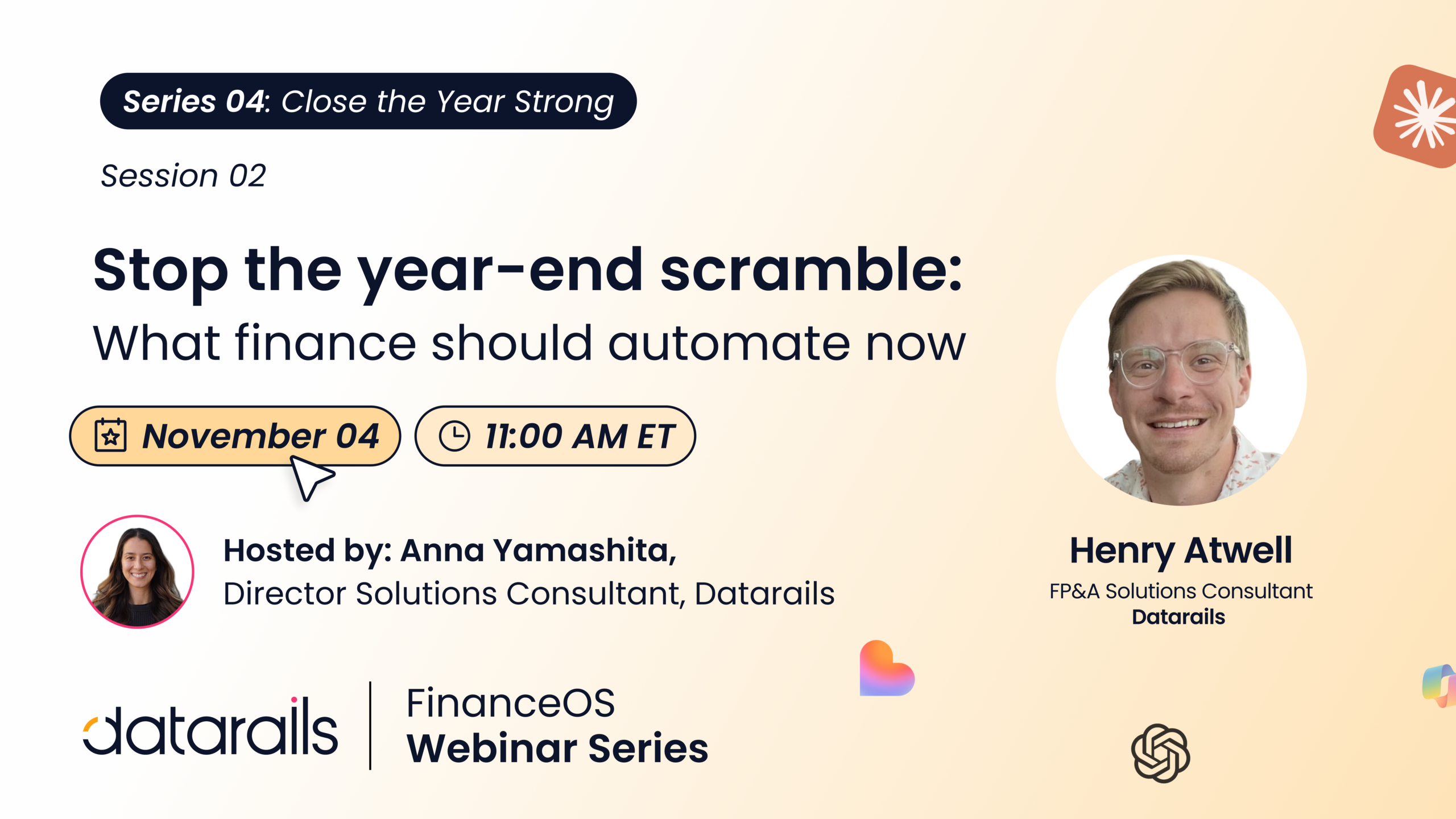
- The session: On Nov 4, Datarails' Henry Atwell shows real examples across variance investigation, commentary and reporting, and how to sort tasks into AI and human.
It’s the second week of January. The books for the year are closed, and a four-person FP&A team now has the year-end pack to produce. Every task on their list is familiar, because they did most of it last year, and the year before.
By the time the pack goes out, the team has spent about 180 hours on it. Almost none of that went on deciding anything.
Perhaps it’s time to take a step back and consider which tasks AI can handle and how much time it could save.
Here’s an illustrative example with rounded figures.
| Year-end task | Hours (team total) | Good AI candidate? |
|---|---|---|
| Pulling and matching data from the ERP, CRM and payroll | 40 | Yes: rule-based and repeatable |
| Investigating variances against budget and last year | 60 | Mostly: AI finds the drivers, a person confirms them |
| Drafting commentary for each variance | 30 | First draft: a person edits and signs off |
| Rebuilding recurring reports and the board pack | 50 | Yes, once each report is defined |
| Total | 180 |
That’s more than a full working week each, spent assembling the year rather than explaining it. And it lands at the moment leadership most wants answers.
Why the year-end close process turns into a scramble
Year-end is month-end with the volume turned up. The same steps run, but across twelve months instead of one, with more variances to explain and more people waiting on the result.
Most of the work also repeats. The team pulls the same data, runs the same checks and writes commentary in the same format every year, but each cycle starts from a blank spreadsheet. Nothing carries over except the deadline.
How to hand a task to AI, and trust what comes back
The table shows where the hours go. The harder part is handing a task to AI without someone redoing it by hand later. Start with a quick test: does the task repeat, follow rules you could write down, and run on data you can trace to source? Three yeses make it a strong first candidate.
Then, for each task, settle two things up front: what AI needs to do it well, and how your team will check the result.
- Data pulls and matching. Give it the source systems and a mapping of accounts and entities. Check that totals tie to the trial balance for each entity.
- Variance investigation. Give it the budget version to compare against and your materiality threshold. Check that each explanation points to the transactions behind it, so a reviewer can click through instead of taking it on trust.
- Commentary. Give it the confirmed variance findings and last year’s commentary as a style guide. Check that the owner of each line edits and signs off before it goes anywhere.
- Recurring reports. Give it a fixed definition of each report and metric. Check the first automated run against the manual version before you retire the old process.
Timing matters too. Pick one task now and run it alongside the manual process for the November close. By year-end, your team will have seen it work on a real month and will know exactly where it still needs a human eye.
See Datarails FP&A Solutions Consultant Henry Atwell sort real year-end tasks between AI and people, live, in our FinanceOS webinar.
Year-end close process automation that holds up
Automation only helps if the team trusts what comes out. If AI pulls numbers that don’t tie to the books, or explains a variance with the wrong definition of revenue, someone has to redo the work by hand, and the hours come straight back.
That’s why the order matters. First, get the data in one place, with each metric defined once and every number traceable to source. Then point AI at the repetitive work, starting with the tasks that pass the three-question test. Keep a person on every output that reaches leadership, at least until the results have earned trust.
That foundation is what FinanceOS® gives finance teams: connected data and shared definitions, so AI works from the same numbers your team signs off.
See it live on Nov 4
In Stop the year-end scramble: What finance should automate now, Henry Atwell, Datarails FP&A Solutions Consultant, takes a practical look at the repetitive year-end work AI can take off finance’s plate. You’ll leave with:
- How to identify which tasks are good candidates for AI and which still need human judgment
- Real examples across variance investigation, commentary and reporting
- Ideas for reducing repetitive work before year-end
Nov 4 · 11 AM ET · Live online
It’s the second session of Close the Year Strong, our four-part year-end series. Missed headcount planning on Oct 28? Watch it on demand. Next: AI-powered finance workflows in Datarails (Nov 11) and the Q4 re-forecast and board conversation (Nov 18).
Back to January
Run the same team through the year-end pack with the data pulls and recurring reports automated, and with AI drafting the first pass on variances and commentary. In this illustrative example, the 180 hours drop to around 30, most of them spent reviewing and deciding.
The pack goes out sooner, and the team spends its time on the questions leadership is asking.
Session 2 of Close the Year Strong, Nov 4 · 11 AM ET